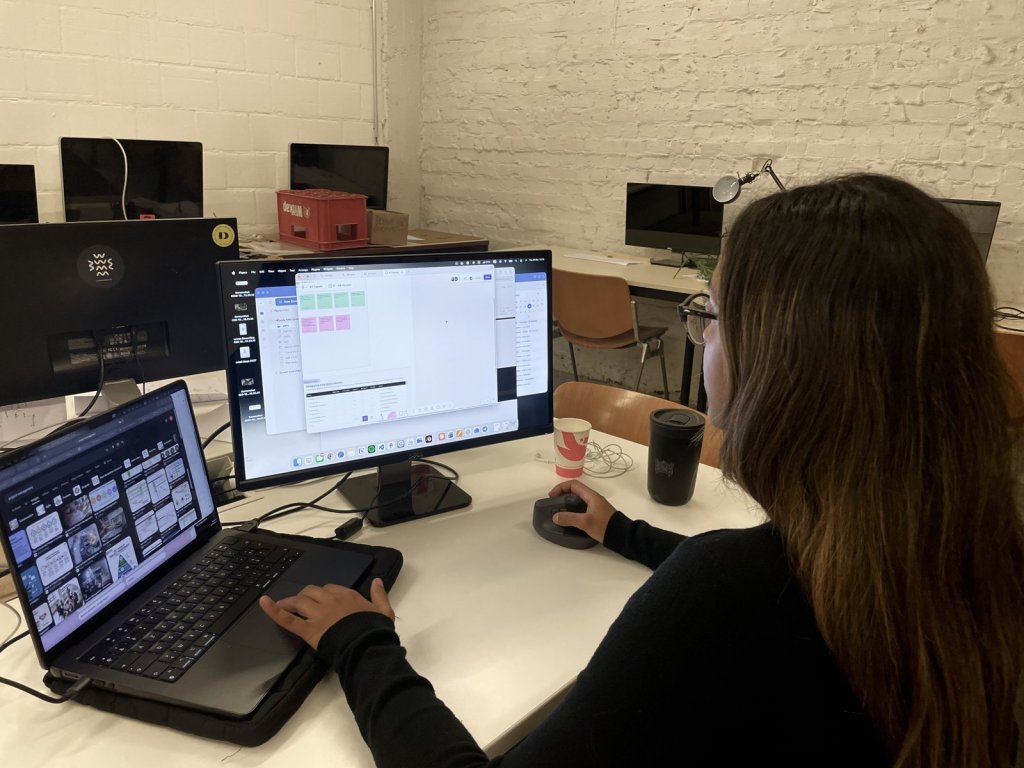
On Saturday 12 December 2026, from 17:00 to 22:00, the Transfo site in Zwevegem becomes an evening route of light, music and art for Transfo Intiem (transfozwevegem.be). This year’s theme is adem, breath. Our brief asks us to design an interactive installation for that route.
Before sketching any ideas, we spent our first working day on discovery. Our goal was to separate what we were told, what we assume and what we still need to find out.
What the brief tells us
According to the brief and the client’s pitch, the event is a walking route of about one kilometre. Previous editions drew more than 1,500 visitors, and the target audience is aged 5 to 80, with many families. The installation has to be intuitive without instructions, safe for young children, and in keeping with the industrial site.
We can choose between two assignments:
- Option A: an indoor installation in the Pompenzaal, a hall shared with up to two other student groups.
- Option B: a visual or physical experience that responds to a soundscape made by students from the Academy of Arts.
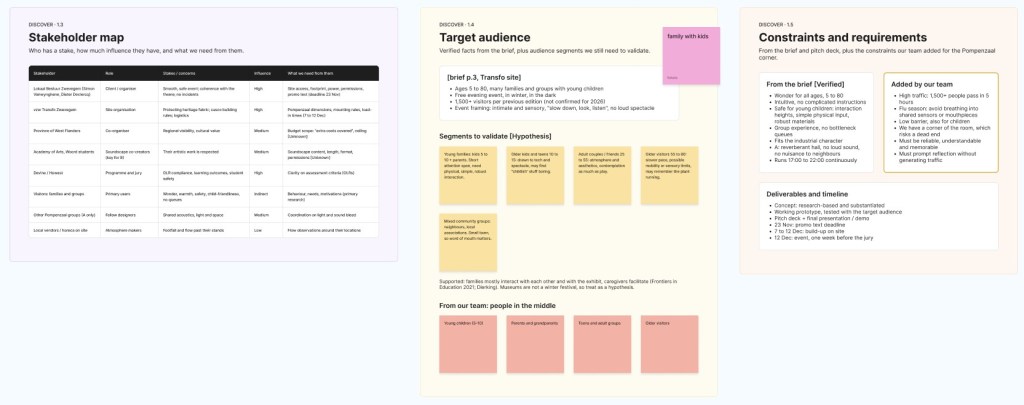
Who is involved
We mapped everyone with a stake in the project, and what we need from each of them:
- the municipality of Zwevegem, our client
- vzw Transfo Zwevegem, which runs the site
- the Province of West Flanders
- the Academy of Arts students, for option B
- Devine
- the other groups in the Pompenzaal
- the visitors themselves
Several of them hold answers we can’t find online, such as the size of the Pompenzaal, what can be mounted there, and the budget.
Who we are designing for
“Ages 5 to 80” isn’t one audience. Rather than describing what each age group wants, we listed segments to validate: young families, older children and teens, adult couples and friends, older visitors, and mixed community groups. We also mapped possible ways people might take part:
- discovering the interaction
- reaching it
- understanding its response
- joining others
- choosing to watch instead
We haven’t tested any of this with visitors yet.
Existing breath-related and interactive installations
We started with a reference scan to see how others have turned breath, and bodies in a space, into an experience:
- Breath of Light by Preciosa (Milan, 2018): visitors blow into four sensing points around a cloud of crystal bubbles, which light up with reactive sound.
- Prana by B-Reel: a radar sensor reads one participant’s breathing and drives more than 13,000 LEDs in a suspended sphere.
- Breath of Light by Pinyao Liu (Shanghai Biennale, 2021): two participants’ breathing is translated into synchronised light and ambient sound.
- The Room Holds Its Breath by Lauren Walker (Winterwerkschau, Bauhaus-Universität Weimar, 2025): a mechanical lung responds to the CO₂ level in the room. As it rises, the lung struggles, then stops until the air clears.
- Sonic Light Bubble by Studio ENESS: a six-metre inflatable that responds with light and sound when people approach and touch it, rather than to their breath.
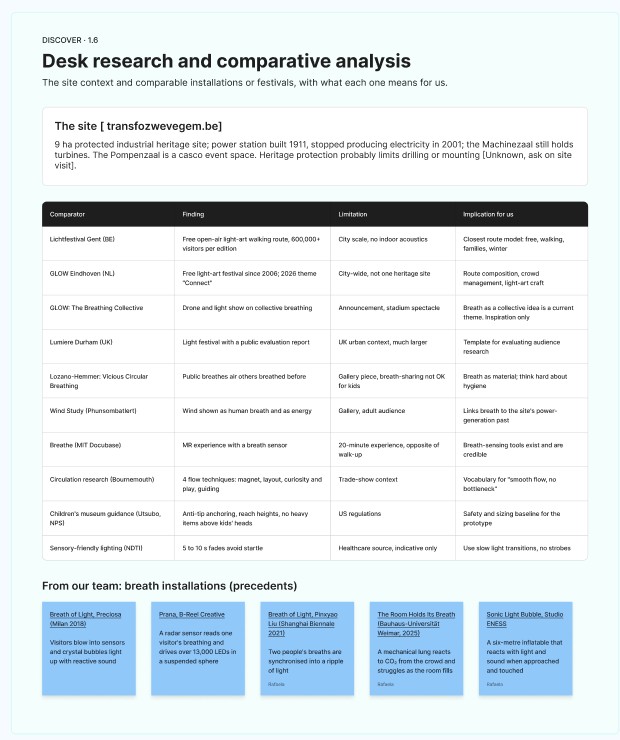
These references show several different interaction models:
- sensing one person’s breath
- paired breathing
- several blowing points at once
- sensing CO₂ across a whole room
- responding to approach or touch
We can’t yet tell which would suit our route. Instead, we used them to find questions:
- Taking part at the same time: how many people can take part at once on a busy route?
- Hygiene and willingness: would visitors want to blow into a shared sensor?
- Setup time: would the sensing approach require visitors to stop, position themselves or wait for calibration?
- The venue: can a sensor tell breathing apart from background sound in an echoing hall?
We also gathered further references to investigate, including light festivals such as Lichtfestival Gent, GLOW Eindhoven and Lumiere Durham, research on visitor flow, and guidance on children’s exhibits and lighting.
Our research question
Our first question already described a solution: visitors breathing, a visual result, no sound. We broadened it to:
How might we help visitors of different ages and abilities experience the theme of breath during a short encounter on the route?
Underneath it sits a question we want to explore with visitors: what does breath mean to a five-year-old, and to an 80-year-old? Where do those meanings overlap?
Breathing usually happens without conscious attention. Changes such as cold air, effort or calm can draw our attention to it, but we can also notice it deliberately. That tension between automatic and aware feels like a good place to start.
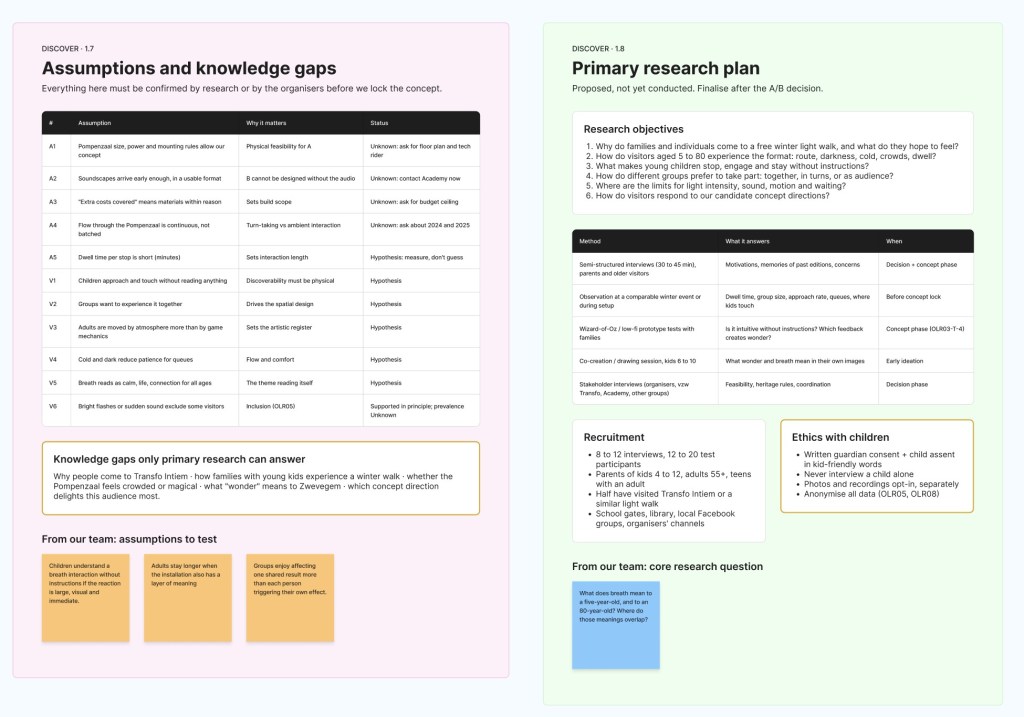
What we don’t know yet
Practical unknowns
- What the Pompenzaal’s dimensions and power supply would allow us to build, and what we may mount there.
- When the soundscapes for option B will be ready.
- How visitors arrive: in a steady flow or in groups.
Visitor hypotheses
- Some children may try touching before looking for guidance.
- Groups may prefer a shared experience.
- Atmosphere and game-like interaction may appeal differently to different visitors.
Accessibility questions
- How can visitors take part without blowing or controlling their breath?
- How can people choose to watch instead?
- Which light and sound choices should we avoid or adapt?
A breath-responsive light installation is one direction we’re considering, but we haven’t committed to it.
How we’ll find out
Our research plan is a proposal, which we’ll finalise once we’ve chosen between A and B. Different activities answer different questions:
- To explore associations, expectations and meanings: short interviews with visitors, and a drawing session with children about what breath and wonder mean to them.
- To understand behaviour in context: observing visitors at a comparable winter event.
- To test discoverability and participation: low-fi prototype tests with families.
- To check what’s feasible: conversations with the organisers and other stakeholders.
We’ll recruit across age groups and participation needs, and prioritise the uncertainties most likely to affect our design. We won’t treat a few conversations as representative of the whole audience.
Before involving children, we’ll follow Howest’s research and safeguarding procedures. We’ll get informed consent from a parent or legal guardian and ask each child for their own agreement in words they understand. Taking part will be voluntary, and we will never interview a child alone. We’ll keep personal data to a minimum, store it securely, and remove identifying details from anything we publish. Photos, recordings and sharing children’s drawings will each be covered separately in the consent process.
Option A or B?
Both options have strong points. A gives us a known, sheltered space, but we would share an echoing hall with other groups. B offers built-in sound and a collaboration with the Academy, but depends on soundscapes and a location we don’t know yet.
We drafted questions for the client about:
- the Pompenzaal’s dimensions, power and light
- a map of the site
- when we can visit
- whether we can hear the soundscapes
Their answers will help us choose an assignment and understand which directions are feasible before we commit to a concept.
Next
Once we hear back, we’ll visit the site, make the A/B decision and start our first conversations with visitors.

