There are three of us, one client and about six weeks until the event. We need to keep track of what needs doing, who is responsible and when we can work together.
We use a GitHub Project board for our tasks and a shared planner in FigJam for our availability.
Our tasks: a GitHub Project board
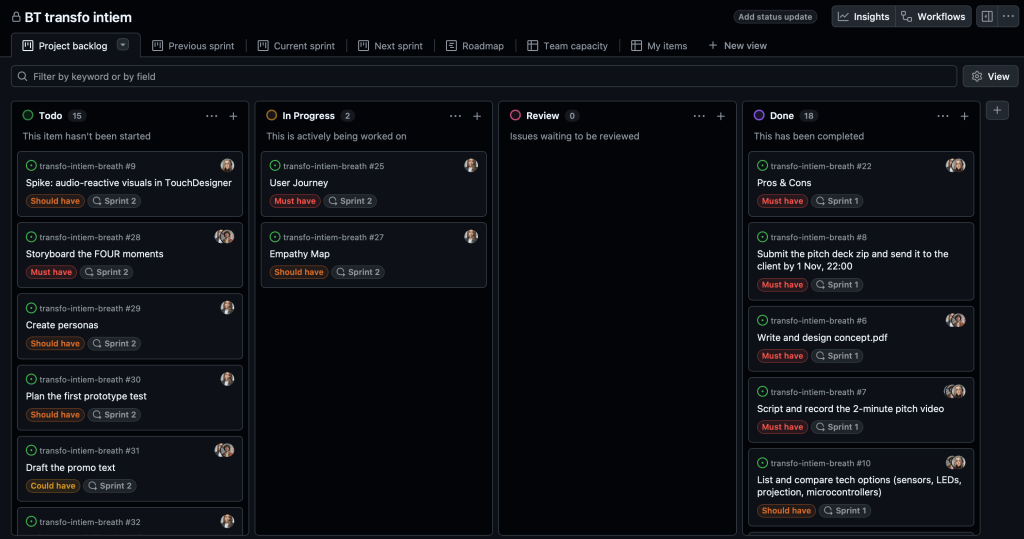
We keep our tasks on a GitHub Project board called “BT transfo intiem”. Each task is an issue, whether it’s something small like “First test print of a flower head” or a larger deliverable like “User Journey”.
Every issue has an owner, so we know who is responsible. Tasks move through four columns:
- Todo: not started yet.
- In Progress: someone is working on it.
- Review: ready for a teammate to check.
- Done: checked and completed.
The Review column is important to us. Before a task moves to Done, someone other than its owner looks at it. This gives us a chance to catch problems and give feedback along the way.
Setting priorities
We use priority labels based on the MoSCoW method: Must have, Should have and Would be nice to have.
These labels help us decide what to work on first and what can wait if we run short on time. For example, “TouchDesigner fireflies” is a Must have, while “First test print of a flower head” is nice to have at this stage.
We can adjust these priorities as the project develops.
Working in sprints
We divide the work into sprints of roughly two weeks, each leading to a milestone.
| Sprint | Milestone |
|---|---|
| Sprint 1 | Choose the concept, supported by research and moodboards |
| Sprint 2 | Present the project pitch |
| Sprint 3 | Test a beta prototype |
| Sprint 4 | Deliver the installation for the event on 12 December |
Jury week follows the event.
The board has separate views for the previous, current and next sprint. During meetings, we can focus on the current work without going through the entire backlog.
We also use a roadmap view to check the overall schedule and a team capacity view to see how tasks are divided between us.
Our time: a shared planner in FigJam
GitHub shows us what needs to happen, but not when everyone is available. Two of us also have jobs, so our free hours don’t always overlap.
We made a shared planner in FigJam covering November and December, week by week. Each person has a colour, and we place sticky notes on the calendar for:
- Deadlines.
- Meetings with Transfo and our coach.
- Expert desk feedback sessions.
- Work shifts and other commitments.
- Build days and the event.
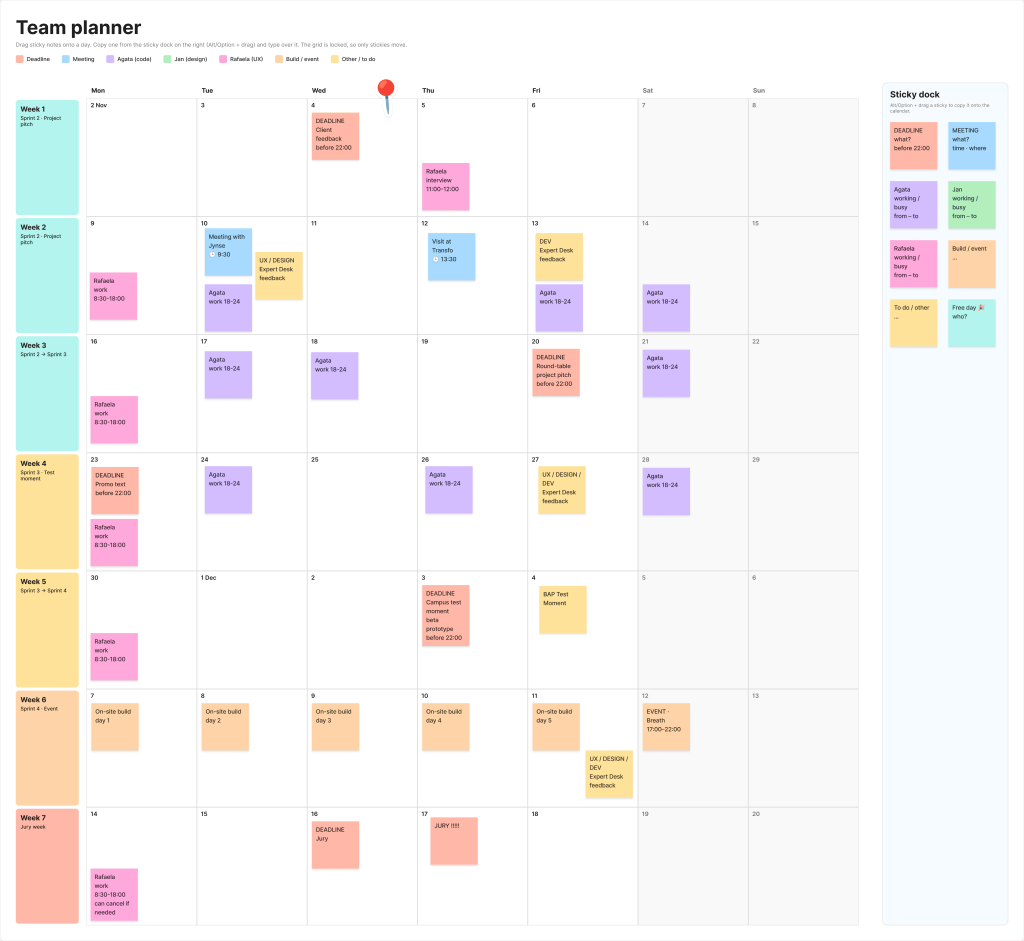
This helps us find time to meet and plan build sessions when people are available. It also makes busy weeks easier to spot in advance.
Key dates
| Date | Activity |
|---|---|
| 12 November | Visit to Transfo |
| 20 November | Roundtable project pitch |
| 23 November | Promotional text due to Transfo |
| 3 December | Campus test with a beta prototype |
| 7 to 11 December | Setup on site |
| 12 December | Transfo Intiem, 17:00 to 22:00 |
| Mid December | Jury |
How it’s going so far
We’re still at the beginning of the project, so it’s too early to say what will work for the whole six weeks. For now, the board helps us keep track of tasks, and the planner helps us find time to work together.
So far, we feel on track. As we start building and testing, we’ll see what needs to change.

