This sprint was about pulling everything together for our project pitch on 20 November.
The goal
For the project pitch we had to show three things: how we handled the client’s feedback, what already works, and what comes next. That meant turning separate experiments into one working demo, and replacing the flowers with something sturdier.
Tasks
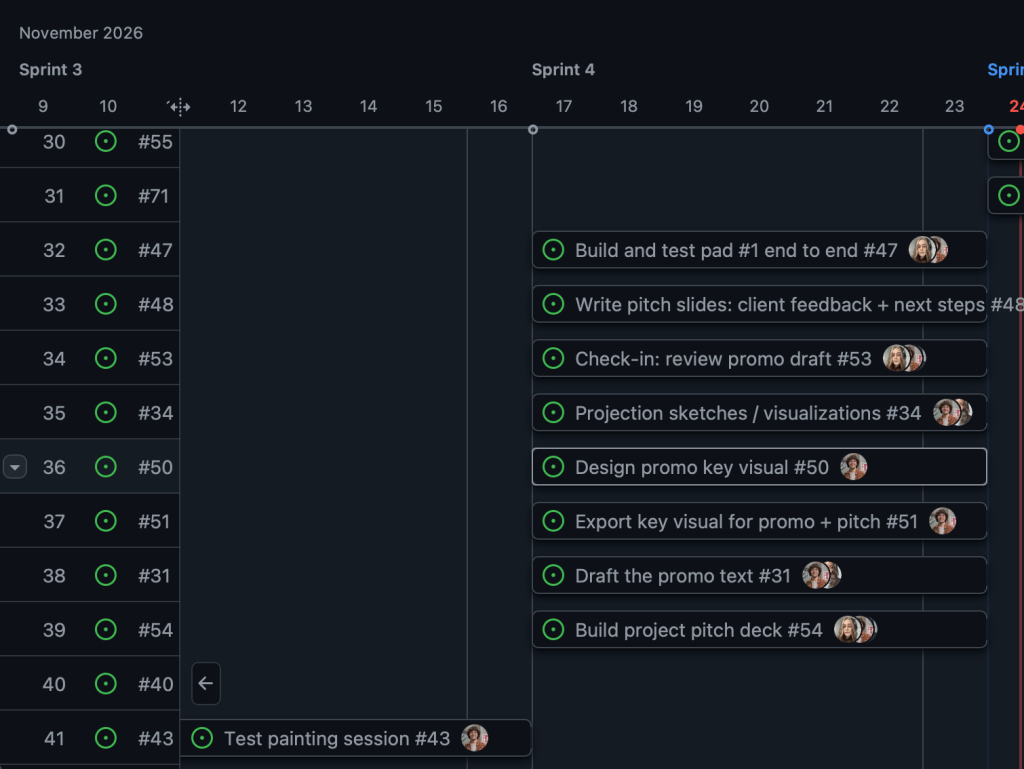
| Dates | Task | Who |
|---|---|---|
| 17 – 23 Nov | Draw the forest scene for the projection | Rafaela |
| 17 – 23 Nov | Sketch the rabbit animation | Rafaela |
| 17 – 23 Nov | Record the demo of the first prototype | Rafaela, Agata |
| 17 – 23 Nov | Merge the firefly demo and the two-projector demo into one TouchDesigner file | Agata |
| 17 – 23 Nov | Write the floor pad code and connect it to TouchDesigner | Agata |
| 17 – 23 Nov | Build and test the first pad | Agata, Jan |
| 17 – 23 Nov | Write the promo text | Jan |
| 17 – 23 Nov | Pitch slides: client feedback and next steps | Jan |
| 17 – 23 Nov | Build the project pitch deck | Jan |
| 17 – 23 Nov | Review the promo text before the final version | Rafaela, Agata, Jan |
What came out of it
For the first time, the fireflies and the two projectors ran from one TouchDesigner file, and we recorded that as our demo. The forest scene gave the projection its first real look, and the rabbit sketch was the start of the animals that appear when visitors step on the pads.
On the hardware side, we wrote the code for the floor pads before all the parts had arrived. That way, building the first pad was mostly a matter of plugging it in and testing it.
The pitch deck brought it all together: the client’s feedback, how we answered it (no flower canopy, no breath sensors, pads instead of flowers) and our plan for the last weeks.

